Maple Chopping Board — End-Grain Wooden Chopping Board
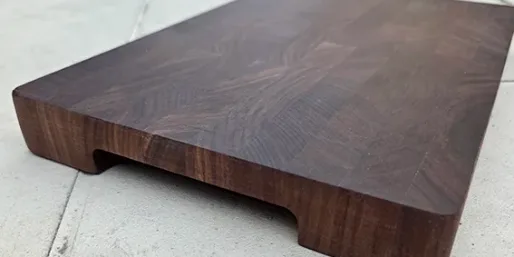
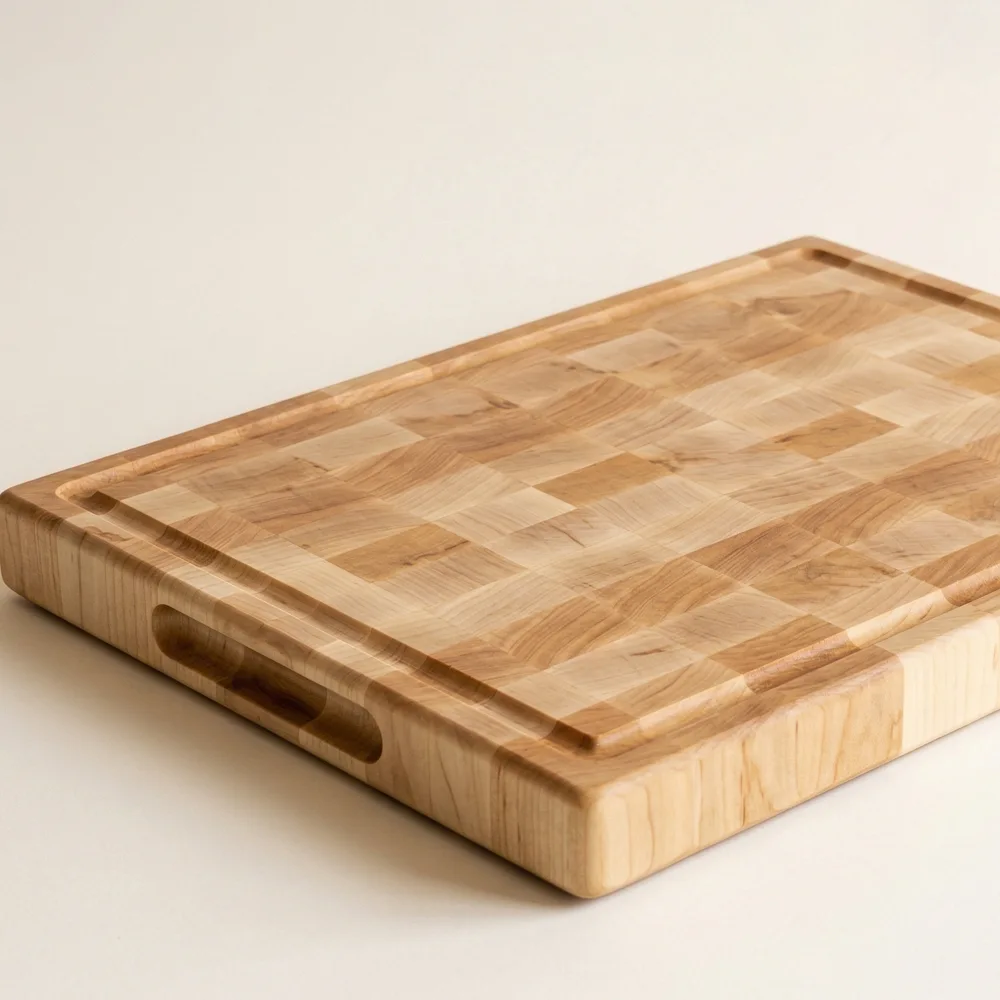
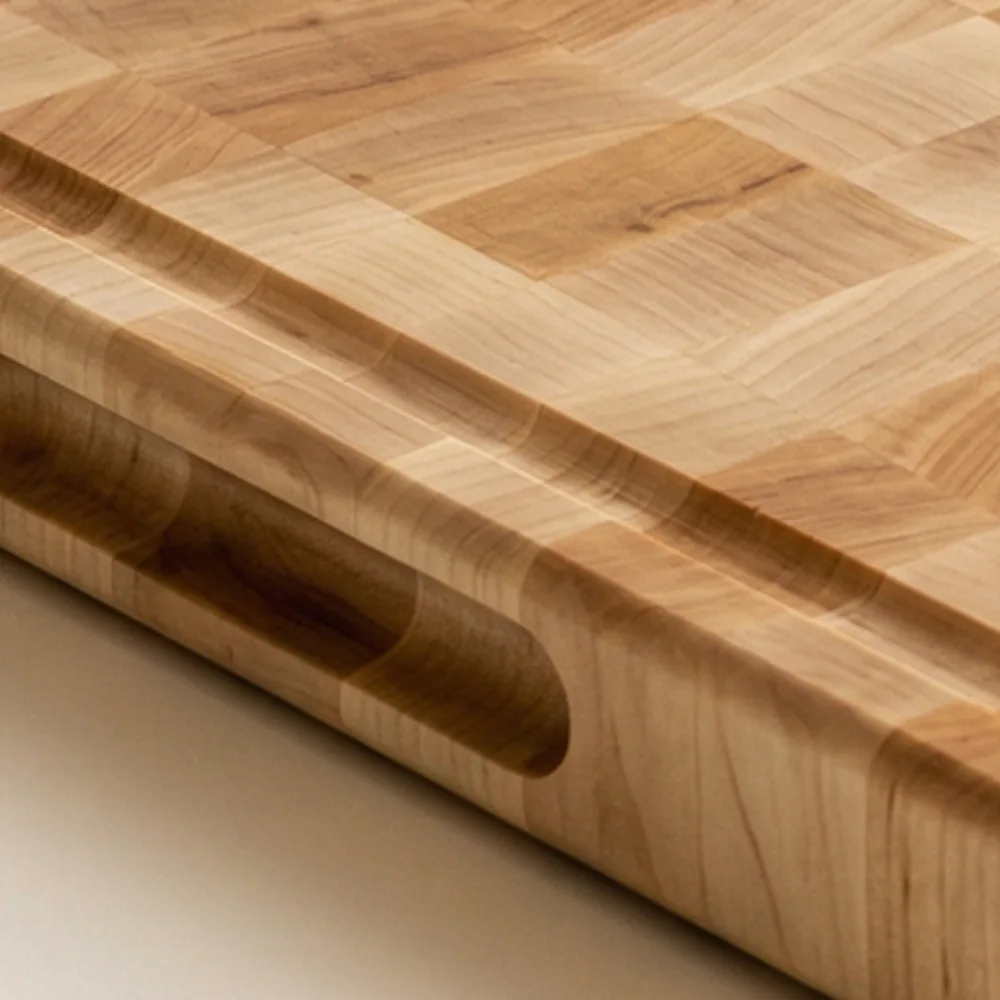
A solid end-grain Maple wooden chopping board with handles. This solid butchers block is built to outlive its owner. End-grain construction is the most hygienic choice and the kindest finish for your knives — softer than bamboo, tighter-grained than oak.
Made to order · dispatched in ~7 days · secure checkout
| Wood | Maple Wood, end-grain construction |
|---|---|
| Dimensions | 43 × 33 × 4 cm (16.9 × 13 × 1.6 in) |
| Weight | 4.2 kg (9.3 lbs) |
| Features | Integrated handles |
| Finish | Food-safe mineral oil |
| Origin | Made in the United Kingdom |
| EAN / GTIN-13 | 5056722006948 |
Why End-Grain Maple
End grain maple boards expose the cut ends of the wood fibres so that knife edges slip between them rather than slicing across them. The result: blades stay sharper for longer, and the surface self-heals over time. Hard Maple sits in the sweet spot — dense enough to resist scoring, soft enough to be kind to steel, and tight-grained enough to stay hygienic. Unlike bamboo it won’t dull your knives, and unlike oak it doesn’t trap moisture.
Care & maintenance
Rinse your maple chopping board under warm water and wipe dry after use. Never put your board in the dishwasher or leave it submerged. When the surface looks dry, refresh with a coat of Cloumann board oil — once a month for the first six months, then a few times a year. With this care, your board will outlive most of your kitchen.
Delivery & returns
Free delivery across the UK. As each maple cutting board is made to order, dispatch is approximately seven working days from purchase. Items can be returned — please contact us.
I ruined a lot of chopping boards before I made this one.
For years I bought whatever chopping board was available and cheap. Plastic chopping boards are cheap, dishwasher-safe, and within a few months carved with gashes deep enough to catch a fingernail. Every one of those cuts is plastic that left the board, and once I thought about where it had gone, I couldn’t stop thinking about it. We were eating it.
So I went the other way and bought marble. It is beaautiful, heavy and wipes clean. However, it took the edge off a good knife in a matter of weeks. When steel meets stone, something has to give, and it is never the stone.
Wood was obviously the answer, so I bought wooden boards, and they were better. But they were all side-grain, and after a year they looked it: a grey mesh of cut lines across the whole face that sanding never really fixed. I was slicing across the fibres every single time.
That was when I started reading properly, and found the distinction nobody had ever mentioned to me: end-grain versus side-grain. Stand the fibres on end and the blade slips between them instead of cutting through them, and the surface closes back over itself afterwards. Then the only question left was which wood — and once I had worked through the options (I have graded them below), hard maple kept coming out on top. Dense enough to last decades, soft enough to spare a knife, tight-grained enough to stay genuinely clean.
I couldn’t find a maple chopping board I actually wanted to buy in the UK. So I started making them.
Lars B. Andersen · Founder, Cloumann
Which wood makes the best end-grain chopping board?
End-grain construction is only half the answer — the wood you build it from matters just as much. Here is how the nine timbers most often sold as chopping boards actually perform, marked on three things: how kind they are to a knife edge, how well they resist moisture and bacteria, and whether they still look good after years rather than months.
-
Maple What we make— grade A
Hard sugar maple is the benchmark, and has been in professional kitchens for a century. Dense enough to resist scoring, soft enough to leave a knife edge intact, and tight-grained enough that liquid and bacteria have nowhere to hide. In end-grain it genuinely self-heals: the fibres close back over the cut.
-
Walnut — grade A
American black walnut is a little softer than maple, which makes it kinder still to steel. Closed-grained, stable, and dark enough that a season’s marks simply disappear into the colour. The only real reason it isn’t the default is what it costs.
-
Elm — grade B
The traditional English butcher’s block. Its interlocked grain makes elm almost impossible to split, which is exactly the property you want in an end-grain block. Marked down only because good elm has been scarce since Dutch elm disease, and it is coarser and thirstier than maple.
-
Ash — grade B
Hard, springy, tough and easy to source. The catch is the pores: ash is ring-porous, so those open vessels hold water and food residue and demand more disciplined drying than a closed-grain board. A good board that asks more of you.
-
Acacia — grade C
“Acacia” wood covers dozens of species with wildly different densities, so you rarely know what you are actually buying. The better ones perform respectably. The cheap ones are soft, over-glued, and cup or warp inside a year.
-
Oak — grade D
Handsome, hard-wearing, and the wrong wood for an end-grain board. The large open pores trap moisture and food, and breed bacteria. Its tannins react with steel and acidic ingredients to leave grey-black staining you cannot wash out. Side-grain is passable, but end-grain is a no.
-
Olive — grade D
Spectacular to look at and extremely dense. Olive chopping boards are close to twice the hardness of maple, so it takes the edge off a knife quickly. Olive wood natural oils mix with the glues when building an end-grain olive cutting board, so it moves and might even buckle as it dries. Keep it as a beautiful serving board.
-
Teak — grade D
Naturally oily and superbly water-resistant, which is why boatbuilders love it. It also carries silica in the grain. Silica is the abrasive that blunts sawblades in the mill and will blunt your knife on the worktop. Most teak is not sustainably grown.
-
Bamboo — grade F
Not a wood at all but a grass, and it fails twice over. It is very hard and high in silica, so it dulls knives faster than any wood. Because the fibres run in long strips, it cannot be built as a true end-grain butchers block (only as a glued laminate held together with a great deal of adhesive).
Graded for end grain construction specifically. Several of these woods behave quite differently as side-grain boards or as serving boards — olive and teak in particular are lovely for presentation, just not for chopping.