You want to have the very best chopping board from the very best materials, but what are the “best” wood types to use for a chopping board, and why? Firstly, we need to separate chopping boards into two types, side grain and end grain.
[image side grain vs end grain]
Side grain
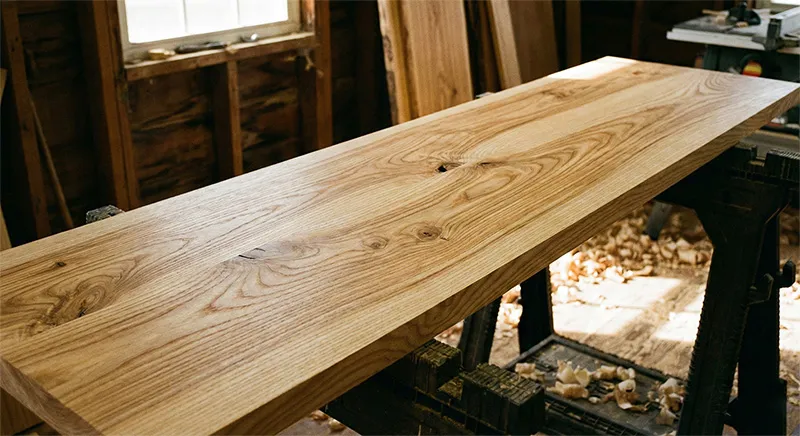
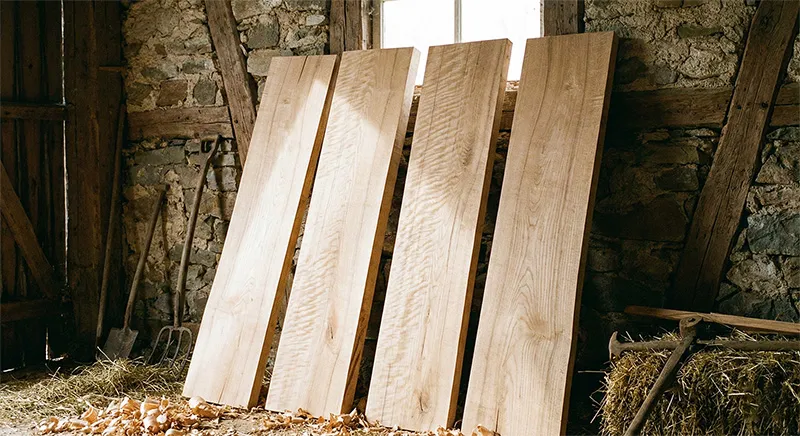
The easiest way to make a chopping board is to take one plank and cut it to the right width of the chopping board. If you want a deeper chopping board, you can glue two or more planks together. Each plank is in the growth direction or grain of the tree, so planks laid down are side grain. This is a very simple and cheap way of making a cutting surface.
As you cut on this side grain, it is a bit like chopping the side of a tree with a sharp axe. You are cutting gashes into the surface of the planks, and over time, you will chop away bits of the wood. When you cut meat or fish on such a board, the deep cuts might harbour humidity and bacteria.
End grain
An end grain board is made slightly differently. A number of staves or planks are glued together, and the whole strip is cut to the height of the board (typically 4 cm for Cloumann boards). These strips are then glued together to form the rectangle of the chopping board or butchers’ blocks. Such an end grain board will have all the fibres facing upwards towards the cutting surface.
As your knife hits the end grain, the wood fibres bend aside, and as you remove your knife, the fibres close back. This is much better for your knife and avoids the deep cuts into the board that can harbour bacteria. This is the reason why most butcher blocks are end-grain.
[Image: Comparison side vs end grain. Hygienic: End grain: ++, Side grain: -. Knife dulling: End grain: ++, Side grain: -. Cost: End grain: ££, Side grain: £.]
Now that we have cleared up the difference between end grain and side grain, we hope that you agree that if you buy a premium chopping board for yourself or as a gift, you want to make it an end-grain one.
The next factors to consider are:
Janka Hardness
Introduction to Hardness (or End-grain Janka Hardness)
When choosing wood for your chopping board, you want to select a material that is hard enough to cut on yet soft enough not to seriously blunt your knives. The main method to measure hardness is the Janka Hardness scale. It measures the force needed to drive a metal ball into a piece of wood, as a measure of hardness.
Why are all Janka Hardness numbers wrong for end grain chopping boards?
You can find a lot of Janka Hardness numbers on the internet. All of these are focused on side grain hardness, not end grain hardness. Side grain hardness is irrelevant for an end grain chopping board, you have to specifically use end grain hardness measures.
How to measure Janka Hardness
Pore size
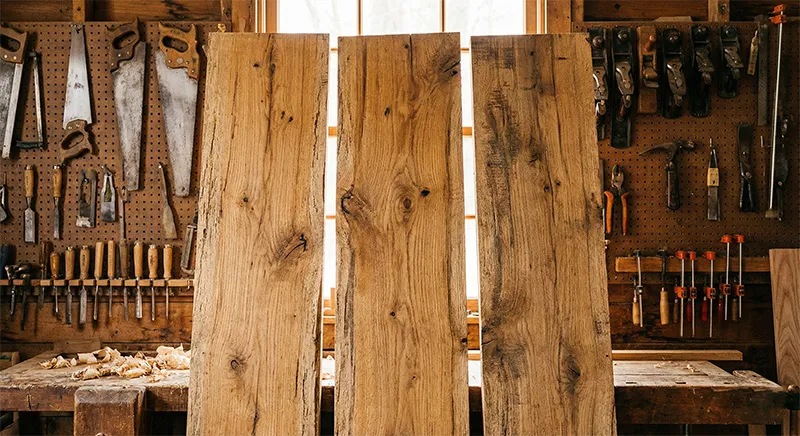
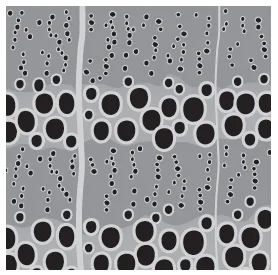
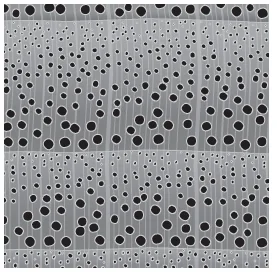
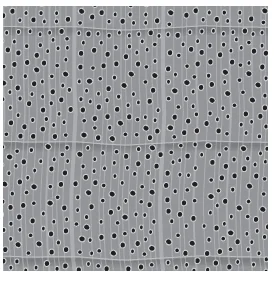
Different woods have different pores inside the wood. This is very different for end and side grain. It does not matter too much when you have a side grain chopping board, but it is very important for end grain wood. Oak, for example, is not a great wood for end grain chopping boards, because oak is ring porous with big open pores and humidity (and therefore bacteria) gets trapped in them.
There are three main types of pores:
where there are large pores located with the growth rings
where the pores are partially linked to the growth rings
where the pores are distributed evenly in the wood
Dimensional stability
Another aspect that is more important for end grain wood is dimensional stability. A stable wood is not going to move and make your chopping board change shape.
Toxicity
Many woods contain toxic chemicals. It is fairly logical that we try to avoid woods that are releasing toxins.
Silica content
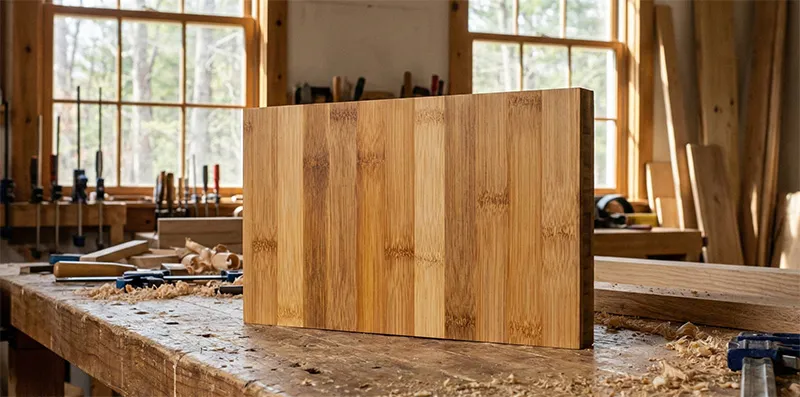
Some materials have a strong silica content, in particular bamboo. These silica crystals in the chopping board will dull your knife and is why bamboo is not a great material for cutting on.
Resin content
Some wood has a strong resin content. This may also dull your knives.
Hardwood Suitability for End-Grain Boards
An end-grain board exposes the cross-section of the wood, so the structure of the pores matters as much as raw hardness. Here is how the woods we work with — and a few we deliberately don't — compare across the factors that determine how a board performs and ages.
| Wood | Janka hardness end-grain dry |
Pore structure (end grain) |
Dimensional stability | Toxicity | Silica | Resin |
|---|---|---|---|---|---|---|
| Cherry (black) Prunus serotina |
1476 lbf | Excellent (Diffuse-porous) | Good | None | Negligible | None (gum, not resin) |
| Walnut (black / American) Juglans nigra |
1850 lbf | Good (Semi-ring-porous) | Very good | None | Negligible | None |
| Beech (American) Fagus grandifolia |
1,590 lbf | Excellent (Diffuse-porous) | Poor | None | Negligible | None |
| Ash (white) Fraxinus americana |
1,720 lbf | Bad (Ring-porous) | Moderate | None | Negligible | None |
| Oak (white) Quercus alba |
1,524 lbf | Bad (Ring-porous) | Moderate–poor | High tannin (not toxic) | Negligible | None |
| Hard / sugar maple Acer saccharum |
1,846 lbf | Excellent (Diffuse-porous) | Moderate–good | None | Negligible | None |
| Bamboo (natural) Phyllostachys (grass) |
~2,000 lbf | Good (Grass not true pores) | Variable | OK | Bad | None (glue might react) |
| Olive (European) Olea europaea |
~3,400 lbf | Excellent (Diffuse-porous) | Poor | None | Negligible | None |
Sources: Hardness and shrinkage figures derived from the USDA Wood Handbook and Technical Bulletin 479 (Markwardt & Wilson, 1935); pore anatomy and tyloses data from The Wood Database.