The short version
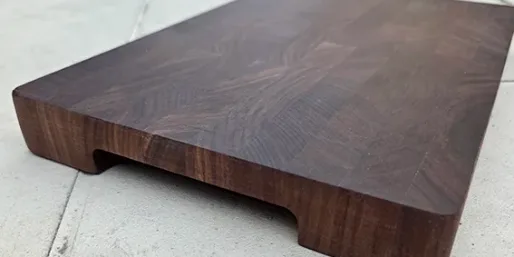
American black walnut is one of the two woods we build every Cloumann board from, and it earns its place on merit rather than looks. It is the most dimensionally stable of the common hardwoods, it is closed-grained enough to keep moisture out, it contains no silica or resin, and it is soft enough to be the gentlest board a good knife will ever meet. The price is the only real argument against it, and the dark colour hides the marks that would show on a paler wood.
What walnut gets right
- Kindest to knives of any board wood: 1,010 lbf side grain, about 1,850 lbf on the end grain.
- The most stable hardwood in the kitchen, with a shrinkage ratio of 1.4. It stays flat.
- Semi-ring-porous with the vessels plugged by tyloses, so liquid does not soak in.
- No silica, no resin, not poisonous once dried. Rated very durable against rot.
- Deep chocolate colour that hides beetroot, turmeric and knife marks.
Where it falls short
- The most expensive domestic hardwood in North America, and it shows in the price of a board.
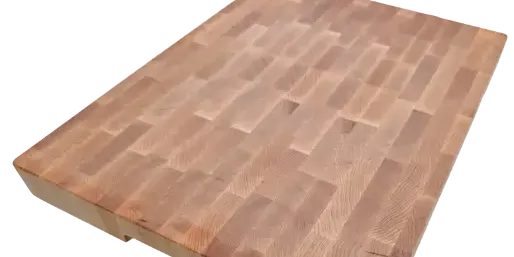
- Softer than maple, so heavy cleaver work leaves marks sooner. On end grain they mostly close again.
- Pale sapwood has to be cut away or steamed, which is part of why it costs so much.
- Lightens a little over years in strong daylight unless it is oiled.
- Juglone in the tree makes people nervous. It should not, but read on.
- Janka hardness
- 1,850 lbfend grain (USDA); 1,010 lbf side grain
- Density
- 610 kg/m³air dry, black walnut
- Pore structure
- Semi-ring poroustyloses common
- Poisonous
- Nojuglone is in the husk, not the dried heartwood
- Silica
- Noneno resin either
- Kind to knives
- Verythe softest board wood we rate
- Stability
- ExcellentT/R shrinkage ratio 1.4
- Cloumann grade
- Awe build end-grain boards from it
What is walnut, exactly?
Walnut is a genus of about twenty trees, Juglans, whose Latin name comes from Jovis glans, Jupiter’s acorn. Two of them matter to anyone buying a board. American black walnut, Juglans nigra, is the big forest tree of the eastern United States, up to 37 metres tall, and the source of almost all the dark walnut timber in the world. English or Persian walnut, Juglans regia, is the orchard tree that gives us the nuts in the fruit bowl. It came to Britain with the Romans, and the “English” label is a triumph of marketing over geography, since it is native to the mountains between Turkey and China.
Black walnut timber is darker and more even; English walnut is lighter, greyer and more wildly figured, which is why gunmakers and furniture restorers hunt for it. Because English walnut lumber comes mostly from felled orchard trees, it is rarer and dearer, and boards of any size are hard to find. Every Cloumann walnut board is American black walnut.
The juglone question
Walnut trees are chemical warriors. Their roots, leaves and green husks produce juglone, a compound that stunts or kills tomatoes, apples, rhododendrons and a long list of other plants that try to grow within reach of the roots. Gardeners know the bare circle under a walnut tree, and horses bedded on fresh walnut shavings can develop laminitis. So it is reasonable to ask whether the wood is safe to cut food on.
It is. Juglone is concentrated in the living tissues, and the heartwood that becomes a board contains only traces. Kiln drying reduces it further, and what remains is bound in the wood and barely soluble in water, so it does not migrate out of an oiled board onto a slice of bread. Walnut has been used for bowls, spoons, salad servers and butcher’s blocks for centuries without incident. The one genuine caveat is that a few people are sensitised to walnut dust and can get a rash from sanding it, which is a workshop hazard rather than a kitchen one.
How hard is walnut? The Janka test
Hardness is measured by pressing a steel ball 11.28 mm across into a block of dry wood until it has sunk to half its diameter, and recording the force in pounds-force (lbf). Black walnut needs 1,010 lbf on the side grain. That makes it the softest wood we would put a knife to, and that is a compliment: a board should give a little, so that the edge of the knife is not what gives.
Two figures matter for an end-grain board. The side-grain number is the one every website quotes. The end-grain number, measured on the cut ends of the fibres, is the one your knife actually meets on a Cloumann board, and for walnut it is far higher: 1,850 lbf in the USDA tests, almost the same as maple’s 1,846. Walnut’s reputation as a soft wood comes from the side-grain figure. Turn the fibres upright and it is as firm as anything in the kitchen, while still parting around a blade rather than resisting it.
Pores and hygiene
Hardwoods carry water up the trunk in vessels, which appear on the end grain as pores. Walnut is semi-ring-porous: the vessels that form in spring are a little larger than those that form in summer, so the growth rings are visible, but there are no bands of gaping earlywood pores as in oak or ash. Better still, walnut’s vessels are commonly blocked by tyloses, balloon-like growths that the tree uses to seal off old plumbing. That is why walnut is rated very durable against rot, and why an oiled walnut board does not drink up meat juice.
Stability: walnut’s quiet superpower
Every wood shrinks as it dries and swells as it gets wet, but not evenly. It moves most around the growth rings (tangentially) and less across them (radially), and the ratio between the two tells you how badly a board wants to cup. Walnut’s ratio is 1.4, the lowest of any common board wood. Maple is 2.1, beech 2.2, plantation acacia 2.8. In practice this means a walnut board is the one that stays flattest through a British winter of radiators and steamy kitchens. For an end-grain board, where dozens of blocks are glued together, that calmness is worth a great deal.
| Wood | Radial | Tangential | T/R ratio | What it means |
|---|---|---|---|---|
| Black walnut Juglans nigra |
5.5% | 7.8% | 1.4 | Very stable. The calmest of the board woods. |
| English walnut Juglans regia |
5.5% | 7.5% | 1.4 | Very stable. |
| Hard maple Acer saccharum |
4.8% | 9.9% | 2.1 | Moderate. Stable once dried to 6 to 8% and glued up as end grain. |
| American beech Fagus grandifolia |
5.5% | 11.9% | 2.2 | Moves a lot in service. |
| Acacia mangium Acacia mangium |
2.8% | 7.8% | 2.8 | Cups readily. |
Is walnut good for knives?
It is the best. Walnut has no silica, the mineral grit that makes bamboo and teak blunt an edge, and no resin. Its side-grain hardness sits just above the 1,000 lbf mark that most knife makers regard as ideal, and on the end grain the fibres open around the blade and spring back rather than being sliced. A Japanese carbon-steel gyuto will keep its edge longer on walnut than on any other wood we know of. The price you pay is that a cleaver or a heavy chop will dent walnut a little sooner than maple. On end grain the dents mostly close, and the dark colour hides the rest.
Colour, sapwood and steaming
The heartwood of black walnut runs from pale brown to a deep chocolate, sometimes with purple or grey in it, and the sapwood around the outside is nearly white. That contrast is a headache for the sawmill. Furniture makers want the dark wood, so most American walnut is steamed after sawing, a process that drives colour from the heartwood into the sapwood and evens the whole plank to a uniform mid-brown. It also dulls the extremes. Unsteamed walnut, which we prefer where we can get it, keeps the deeper purples and the sharper contrast.
Walnut is the one board wood that lightens with age rather than darkening; a board kept in a sunny kitchen will soften to a warm mid-brown over a few years. Regular oiling slows that and keeps the depth in the colour. In return, walnut hides everything: beetroot, turmeric, red wine and the fine grey lines that a well-used knife leaves in a pale board simply disappear into it.
Why is walnut so expensive?
Three reasons. Black walnut is scarce: it makes up only a small fraction of the hardwood standing in American forests, roughly a tenth as much as maple. It grows slowly, and a sawlog is typically sixty to a hundred years old. And a large part of each log is sapwood that either has to be trimmed off or steamed into submission. Add the demand from furniture makers and gunstock makers, and it is the dearest domestic hardwood in the United States. Fine walnut logs sell individually, and the best go to veneer mills that slice them thinner than a millimetre.
Is walnut sustainable?
Yes, with the same caveat as any wood: ask for the certificate. Black walnut is classed as a species of least concern. It regenerates readily, it is planted for timber and for nuts across the American Midwest, and the forests we buy from are FSC-certified, which means an independent auditor checks replanting, wildlife protection and working conditions. English walnut is a different story: the wild populations in Central Asia are listed as near threatened, but the timber trade runs almost entirely on cultivated orchard trees at the end of their fruiting lives.
The one thing walnut is not is fast. Every board is a century of growth, which is another reason to build it to last.
Five things you did not know about walnut
- It is the gunmaker’s wood. Almost every fine shotgun and rifle stock made in the last three centuries is walnut, because it is stable, shock-resistant, and does not splinter under recoil.
- The colour is a family secret. Walnut’s brown is made by the same juglone that poisons tomatoes, oxidised inside the wood. Dyers have used walnut husks for brown cloth and hair dye since the Romans.
- You can drive on it. Black walnut’s tyloses seal its vessels so well that it was used for wooden car dashboards and, in the nineteenth century, for the hubs of cart wheels.
- The nuts fight back. A squirrel can open a black walnut in a few minutes; a person needs a hammer. The shells are so hard that ground walnut shell is sold as an abrasive for blasting aircraft engines clean.
- It lightens, everything else darkens. Cherry, oak and maple all go browner with age. Walnut alone fades towards honey in the sun, which is why antique walnut furniture is often paler than new.
Head to head
Walnut against the alternatives
Side by side, the case for walnut is stability and gentleness on steel. The case against is price, and a little less resistance to heavy chopping than maple.
| Wood | Janka side grain |
Janka end grain |
Density kg/m³ |
Pores | T/R ratio | Poisonous | Silica |
|---|---|---|---|---|---|---|---|
| Black walnut Juglans nigra |
1,010 lbf | 1,850 lbf | 610 | Semi-ring porous | 1.4 | No | None |
| Hard maple Acer saccharum |
1,450 lbf | 1,846 lbf | 705 | Diffuse porous | 2.1 | No | None |
| Black cherry Prunus serotina |
950 lbf | 1,476 lbf | 560 | Semi-ring porous | 1.9 | No | None |
| Acacia Acacia mangium |
1,430 lbf | not published | 585 | Diffuse porous | 2.8 | No | None |
Our verdict
If you own good knives and want the board that treats them best, buy walnut. If you want the board that will still be flat in twenty years, buy walnut. If you want the board that hides a beetroot salad, buy walnut. The only reason to choose maple instead is that it costs less and shrugs off a cleaver a little better, which is why we make both.
Sources: Hardness, density and shrinkage figures from The Wood Database entries for black walnut, English walnut, hard maple, black cherry and mangium. End-grain hardness from USDA Technical Bulletin 479 (Markwardt & Wilson, 1935). Juglone chemistry from the USDA Forest Service and the Wood Handbook. Back to all chopping board materials.