The short version
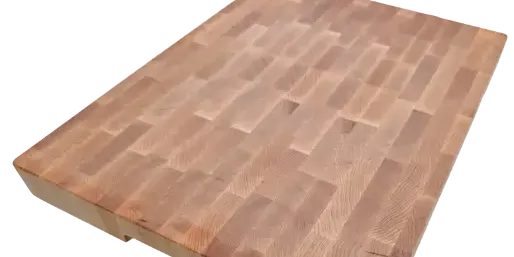
Hard maple is the benchmark. It is the wood that commercial butcher’s blocks have been made from since the nineteenth century, and it is the wood most Cloumann boards are made from, because it does everything a board needs to do and nothing it should not. It is hard enough to shrug off a cleaver, soft enough to spare a knife edge, closed-grained enough to keep liquid out, and it contains no silica, no resin and no toxins. It is also plentiful and affordable. The only things it does not do are hide stains and cost as much as walnut.
What maple gets right
- Hardness right at the top of the sweet spot: 1,450 lbf side grain, 1,846 lbf on the end grain.
- Diffuse-porous with small, numerous vessels: the tightest end grain of any board wood.
- Not poisonous, no silica, no resin. The maple syrup tree.
- End-grain maple genuinely heals: the fibres close behind the knife.
- Abundant, FSC-certified, and the best value of the premium board woods.
Where it falls short
- Pale, so beetroot, turmeric and wine will mark it if left to sit.
- Shrinkage ratio of 2.1: fine when properly dried and glued up as end grain, but not as calm as walnut.
- Non-durable against rot if left wet. Never leave it in the sink.
- “Maple” on a cheap board often means soft maple, at two thirds the hardness.
- Ambers over the years. Some people love that; some prefer it new.
- Janka hardness
- 1,846 lbfend grain (USDA); 1,450 lbf side grain
- Density
- 705 kg/m³air dry, hard maple
- Pore structure
- Diffuse poroussmall, numerous vessels
- Poisonous
- Nothe maple syrup tree
- Silica
- Noneno resin either
- Kind to knives
- Yesfirm but forgiving
- Stability
- GoodT/R shrinkage ratio 2.1
- Cloumann grade
- Aour standard board wood
What is maple, exactly?
Maple is the genus Acer, about 130 species of trees spread across the northern hemisphere, most of them in China. They are the trees with the helicopter seeds, and in autumn they are the reason people drive to New England. Only one of them makes a butcher’s block. Sugar maple, Acer saccharum, grows across the north-eastern United States and eastern Canada, and it is sold as hard maple or rock maple to distinguish it from everything else. Its leaf is the one on the Canadian flag.
The rest of the family is soft maple. Red maple and silver maple are handsome, plentiful and about two thirds as hard. The big sycamore in a British park is a maple too, Acer pseudoplatanus, and at 1,050 lbf it is a soft one; the wood is prized for violin backs and kitchen table tops, but it is not a butcher’s block. Britain’s only native maple, the field maple, is a hedgerow tree too small to make a board of any size. When a board is described simply as “maple” it is worth asking which.
Why butchers chose maple
The end-grain butcher’s block as we know it was invented in the American Midwest in the 1880s, when meat-packing plants needed a surface that could take a cleaver all day and be scraped clean at night. They tried the woods they had, and hard maple won. It was dense enough not to splinter, tight-grained enough not to soak up blood, and cheap because the forests of Michigan and Wisconsin were full of it. Within a generation a maple block was standard equipment in every butcher’s shop, bakery and restaurant kitchen in North America, and it still is. Health inspectors who are suspicious of wooden surfaces in general make an exception for maple, because a century of use has shown it to be safe.
The reason it works is the structure of the wood. Maple is diffuse-porous, meaning its vessels are small and scattered evenly through each year’s growth rather than gathered in open bands. On the end grain those vessels are tiny and numerous, so the surface is close to solid. Bacteria that land on it dry out and die rather than finding a pore to hide in. Studies in the 1990s that compared wood and plastic boards found that maple, far from being the hygiene risk people assumed, out-performed plastic once the plastic was scored.
The self-healing end grain
Every Cloumann board is end grain, and maple is the wood that shows why that matters. Think of the fibres in a piece of wood as a bundle of drinking straws. Lay them flat and cut across them with a knife, and you sever them: that is a side-grain board, and every cut is permanent. Stand them on end and press the knife down between them, and they lean apart to let the blade in, then straighten up again when it lifts. That is an end-grain board. Maple’s fibres are small, straight and closely packed, so they do this better than almost any other wood, and a maple block that has been used daily for ten years can still look almost unmarked.
How hard is maple? The Janka test
Hardness is measured by pressing a steel ball 11.28 mm across into a block of dry wood until it has sunk to half its diameter, and recording the force in pounds-force (lbf). Hard maple needs 1,450 lbf on the side grain, which puts it at the top of the range where a board is firm without being brutal. On the end grain, the surface your knife actually meets on a Cloumann board, the USDA measured 1,846 lbf.
Hard versus soft. Sugar maple is the only maple that earns the word hard. Red maple, silver maple, bigleaf maple and the European sycamore all test between 700 and 1,050 lbf, close to walnut and cherry. They make perfectly good side-grain boards, but a block built from them dents under a cleaver. If a maple board is surprisingly cheap, it is probably soft maple, and the seller is rarely in a hurry to say so.
Is maple poisonous?
No. Sugar maple is the tree that maple syrup is boiled from, forty litres of sap to one of syrup, and nothing in the wood is toxic. It has no silica, the abrasive mineral that makes bamboo and teak blunt knives, and no resin canals. Like most woods, the dust can irritate the nose and skin of the people who sand it all day, which is why we wear masks in the workshop, but a finished, oiled board is as inert as a kitchen surface gets.
Movement and stability
Wood shrinks as it dries and swells as it gets wet, more around the growth rings than across them. The ratio between the two tells you how much a board wants to cup. Maple’s ratio is 2.1: moderate, well behind walnut’s 1.4 but comfortably ahead of beech or plantation acacia. In an end-grain board this matters less than it does in a plank, because the dozens of small blocks are glued up with their grain in alternating directions and hold each other flat. What matters more is that the wood was dried properly before it was cut, to 6 to 8 per cent moisture, and rested. That is where the cost of a good board goes.
| Wood | Radial | Tangential | T/R ratio | What it means |
|---|---|---|---|---|
| Black walnut Juglans nigra |
5.5% | 7.8% | 1.4 | Very stable. |
| Sycamore maple Acer pseudoplatanus |
4.5% | 7.8% | 1.7 | Stable, but soft. |
| Hard maple Acer saccharum |
4.8% | 9.9% | 2.1 | Moderate. Stable once dried to 6 to 8% and glued up as end grain. |
| American beech Fagus grandifolia |
5.5% | 11.9% | 2.2 | Moves a lot in service. |
| Acacia mangium Acacia mangium |
2.8% | 7.8% | 2.8 | Cups readily. |
Colour: the wood that is mostly sapwood
Here maple is the odd one out. With walnut, cherry and oak the prize is the dark heartwood at the centre of the log and the pale sapwood is cut away. With maple it is the other way round. The creamy white that people want in a maple board is the sapwood, and the heartwood is a duller reddish brown that the sawmill grades down. A new maple board is nearly white, sometimes with a faint pink or gold. Over the years it ambers to a warm honey colour, and a fifty-year-old butcher’s block is the colour of toast.
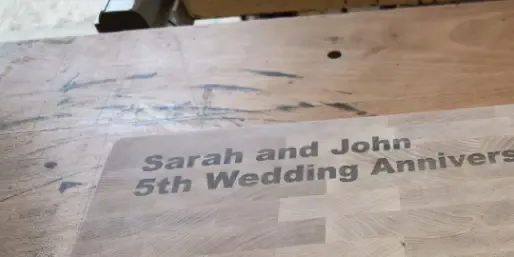
Because it is pale, maple shows what walnut hides. Beetroot, turmeric and red wine will mark it if they sit; most marks scrub out with coarse salt and half a lemon, and an oiled board takes far less than a dry one. What the pale wood gives you in return is a surface that shows when it is clean, which a lot of chefs prefer, and a canvas for engraving and inlay that reads clearly, which is why our personalised boards are maple.
Is maple sustainable?
Yes, and unusually so. Sugar maple is one of the most abundant hardwoods in North America, it is not listed by CITES or the IUCN, and it regenerates naturally: maple seedlings are shade-tolerant, so a managed maple forest replants itself under its own canopy. All Cloumann maple is FSC-certified, which means an independent auditor has checked replanting, wildlife protection and working conditions in the forest it came from. The long-term concern is climate rather than logging. Sugar maple needs cold winters to thrive, and its range is expected to move north over the coming century.
Five things you did not know about maple
- It is the floor of the NBA. Every basketball court in the league is hard maple, chosen for the same reasons as a butcher’s block: it is hard, springy and does not splinter.
- Stradivari used it. The backs, sides and necks of the great Cremonese violins are figured maple, and the flame in a violin back is the same curly grain that turns up in the occasional Cloumann board.
- Bowling alleys, baseball bats and workbenches. The first few metres of a bowling lane, where the ball lands, are maple. So are most modern baseball bats, and so is the top of nearly every serious woodworker’s bench.
- Bird’s eye is a mystery. A small proportion of sugar maples develop a figure of tiny swirling eyes throughout the wood, and nobody has established why. It is worth several times the price of plain maple.
- The leaf on the flag is not quite real. The maple leaf on the Canadian flag has eleven points, which no actual maple leaf has. It was simplified in 1964 so that it would read clearly in the wind.
Head to head
Maple against the alternatives
Side by side, the case for maple is that it has no weakness that matters. The case for walnut over it is stability and colour; the case for anything else is price.
| Wood | Janka side grain |
Janka end grain |
Density kg/m³ |
Pores | T/R ratio | Poisonous | Silica |
|---|---|---|---|---|---|---|---|
| Hard maple Acer saccharum |
1,450 lbf | 1,846 lbf | 705 | Diffuse porous | 2.1 | No | None |
| Black walnut Juglans nigra |
1,010 lbf | 1,850 lbf | 610 | Semi-ring porous | 1.4 | No | None |
| European beech Fagus sylvatica |
1,450 lbf | 1,590 lbf* | 710 | Diffuse porous | 2.0 | No | None |
| Acacia Acacia mangium |
1,430 lbf | not published | 585 | Diffuse porous | 2.8 | No | None |
* End-grain figure measured on American beech, the closest tested species.
Our verdict
Buy maple if you want the board that professionals have trusted for a hundred years, that takes a cleaver without complaint, and that costs less than walnut. Buy walnut instead if you want the board that hides stains and treats a Japanese blade most gently. Whichever you choose, insist on hard maple, insist on end grain, and insist on knowing where the tree grew.
Sources: Hardness, density and shrinkage figures from The Wood Database entries for hard maple, soft maple, sycamore maple, black walnut, European beech and mangium. End-grain hardness from USDA Technical Bulletin 479 (Markwardt & Wilson, 1935). Wood versus plastic board hygiene from Ak, Cliver and Kaspar, University of Wisconsin (1994). Back to all chopping board materials.