The short version
Cherry is a lovely chopping board wood that is slightly too soft to be a great one. It has everything else: a closed grain, no silica, no resin, no toxins in the timber, good stability, and a colour that deepens every year you own it. What it lacks is a little hardness. At 950 lbf black cherry is the softest of the classic board woods, so a cleaver will dent it where maple would shrug. Buy it for a serving board, a bread board or a light-duty kitchen board and you will love it. Buy it for a forty-millimetre butcher’s block and you will notice the marks.
What cherry gets right
- The gentlest board wood on a knife edge: 950 lbf side grain, about 1,480 lbf end grain.
- Semi-ring-porous with small pores, so liquid stays on the surface.
- Not poisonous once dried, no silica, no resin. Heartwood rated very durable.
- Good stability, with a shrinkage ratio of 1.9.
- Darkens from pale pink to deep red-brown, and hides more as it goes.
Where it falls short
- Softer than we would like for a block: heavy chopping leaves dents.
- Gum pockets and mineral streaks are natural, but not everyone likes them.
- The colour change is uneven at first; anything left standing on the board leaves a pale shadow.
- “Cherry” furniture and boards are often stained alder or poplar. Check.
- European sweet cherry is a small tree, so large boards are scarce and dear.
- Janka hardness
- 1,476 lbfend grain (USDA); 950 lbf side grain
- Density
- 560 kg/m³air dry, black cherry
- Pore structure
- Semi-ring poroussmall pores, gum pockets
- Poisonous
- Nothe toxins are in leaves and pits, not the wood
- Silica
- Nonegum, but no resin
- Kind to knives
- Verythe softest board wood
- Stability
- GoodT/R shrinkage ratio 1.9
- Cloumann grade
- Blovely, but soft for a block
What is cherry, exactly?
Cherry belongs to Prunus, the genus of stone fruits: plums, peaches, apricots, almonds and about four hundred other species. Two of them are timber trees. American black cherry, Prunus serotina, is a tall forest tree of the eastern United States and the source of nearly all cherry lumber. It is the wood of Shaker furniture and of most of the cherry boards sold in Britain. The European wild cherry or gean, Prunus avium, is the parent of every sweet cherry in the greengrocer’s, and its timber is a little harder and more richly coloured, but the tree is smaller and the wood is scarce.
Both trees are in the rose family, which makes them cousins of apples and pears, and both share the family habit of sealing wounds with gum. That is where the dark flecks in a cherry board come from. It is also, oddly, why cherry is one of the easiest woods to fake: alder and yellow poplar take a cherry stain so well that a great deal of “cherry” on the market has never been near a cherry tree. The gum pockets are the giveaway. Stained poplar does not have them.
The wood that tans
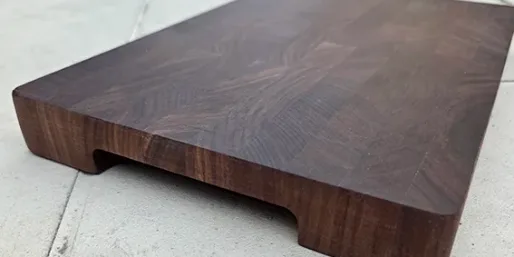
Every hardwood changes colour with age, but cherry does it faster and further than any of them. A freshly planed board is a pale salmon pink with a yellowish sapwood edge. Leave it in daylight and within weeks it warms to amber; within months it is a rich reddish brown; and after a few years it settles into a deep, glowing colour that furniture makers compare to mahogany. The change is caused by ultraviolet light acting on the extractives in the wood, the same chemistry as a suntan, and it happens whether or not the board is oiled.
The effect has a side effect. Anything left standing on a new cherry board, a fruit bowl or a jug, shades the wood beneath it, and when you lift it there is a pale ghost where it stood. It fades as the rest of the board catches up, but for the first year a cherry board wants to be kept clear and turned occasionally, like a loaf in the oven.
How hard is cherry? The Janka test
Hardness is measured by pressing a steel ball 11.28 mm across into a block of dry wood until it has sunk to half its diameter, and recording the force in pounds-force (lbf). Black cherry needs 950 lbf on the side grain, a shade under walnut and two thirds of maple. The USDA’s end-grain figure, the one that matters on an end-grain board, is 1,476 lbf. That is enough for everyday knife work, and it is the lowest of any wood we would put a name to.
Soft is not the same as bad. A board should be softer than the knife, and cherry is. The trade is that a softer surface takes dents from heavy chopping that a harder one would not, and on a pale board the dents show. Cherry gets steadily darker and forgives more as it goes. If you cook with a light hand and a sharp knife, it will suit you well.
Pores and hygiene
Hardwoods carry water up the trunk in vessels, which appear on the end grain as pores. Cherry is semi-ring-porous, tending towards diffuse: a single loose row of slightly larger pores marks each year’s growth, and the rest are small and scattered. It is a close, fine-textured wood, closer to maple than to walnut in how tight the surface is, and it does not soak up liquid. Scattered through it are the gum pockets, small sealed lenses of dark resinous gum where the tree once healed an injury. They look like flaws and are nothing of the kind; a board without any is more likely to be stained alder than cherry.
Is cherry poisonous?
The tree is; the wood is not. Cherry leaves, bark, twigs and pits contain cyanogenic glycosides, compounds that release hydrogen cyanide when the tissue is crushed or wilts. Wilted black cherry leaves have killed cattle, and the reason cherry pits are not meant to be chewed is the same chemistry. None of it survives in the dried heartwood. Cherry has been turned into bowls, spoons, salad servers and pipe stems for as long as there have been lathes, and it is universally regarded as a food-safe wood. The one caution, as with all timber, is for the woodworker: black cherry dust can cause wheezing in the people who breathe it all day.
The bark, meanwhile, has a long career in medicine. Wild cherry bark extract is still a listed ingredient in cough syrups, which is where the taste of cherry cough sweets comes from.
Silica, resin and knives
Cherry contains no silica, the mineral grit that makes bamboo and teak so hard on tools, and no resin canals. The gum in its pockets is sealed and does not bleed. Combined with its modest hardness, this makes cherry about the kindest surface a knife will ever meet. The knife obsessive’s complaint about cherry is never the edge; it is that a heavy chop leaves a mark, and on a young pale board the mark shows until the colour deepens around it.
Movement and stability
Wood shrinks as it dries and swells as it gets wet, more around the growth rings than across them. The ratio between the two tells you how much a board wants to cup. Cherry’s ratio is 1.9, better than maple and beech and only walnut is clearly calmer. It is one of the reasons furniture makers love cherry: a cherry table top made properly stays flat for a century. In a chopping board the same is true, provided the wood was properly dried before it was cut.
| Wood | Radial | Tangential | T/R ratio | What it means |
|---|---|---|---|---|
| Black walnut Juglans nigra |
5.5% | 7.8% | 1.4 | Very stable. |
| Sweet cherry Prunus avium |
5.1% | 8.4% | 1.6 | Very stable. |
| Black cherry Prunus serotina |
3.7% | 7.1% | 1.9 | Good. Low overall shrinkage. |
| Hard maple Acer saccharum |
4.8% | 9.9% | 2.1 | Moderate. Stable once dried and glued up as end grain. |
| American beech Fagus grandifolia |
5.5% | 11.9% | 2.2 | Moves a lot in service. |
Is cherry sustainable?
Yes. American black cherry is listed as a species of least concern, it grows across the eastern United States, often as a pioneer in cleared land, and it is widely available with FSC certification. Pennsylvania alone produces more cherry lumber than the rest of the world combined. European sweet cherry is also common as a tree, but it is a small one, and most of the timber comes from orchard clearances and hedgerows rather than managed forest, so wide boards are rare and priced accordingly.
Five things you did not know about cherry
- It is the Shaker wood. The plain, perfect furniture of the Shaker communities of New England was mostly cherry, chosen because it was local, worked cleanly and needed no stain. Two centuries later it has darkened to the colour people now try to imitate.
- Cherry cough sweets are real cherry. The flavour comes from wild cherry bark, which has been used to calm coughs since the Native Americans taught the settlers.
- The tree that fed a continent. Black cherry fruit is small and bitter to us, but it feeds more species of birds than almost any other North American tree, which is how it spreads so far and so fast.
- The pits are chemistry. Cherry stones contain amygdalin, which breaks down into cyanide. A single swallowed pit is harmless because the shell is not digested; a handful of crushed ones is not.
- Washington did not cut one down. The story of young George and the cherry tree was invented by a biographer in 1806 to sell books. It has outlived every attempt to correct it.
Head to head
Cherry against the woods we use
Side by side, cherry is a softer, warmer walnut. It gives up a little hardness and a little stability, and asks a little less money.
| Wood | Janka side grain |
Janka end grain |
Density kg/m³ |
Pores | T/R ratio | Poisonous | Silica |
|---|---|---|---|---|---|---|---|
| Black cherry Prunus serotina |
950 lbf | 1,476 lbf | 560 | Semi-ring porous | 1.9 | No | None |
| Black walnut Juglans nigra |
1,010 lbf | 1,850 lbf | 610 | Semi-ring porous | 1.4 | No | None |
| Hard maple Acer saccharum |
1,450 lbf | 1,846 lbf | 705 | Diffuse porous | 2.1 | No | None |
| Acacia Acacia mangium |
1,430 lbf | not published | 585 | Diffuse porous | 2.8 | No | None |
Our verdict
Buy cherry for a bread board, a cheese board or a light-duty kitchen board, and enjoy watching it change colour. Make sure it is real cherry, with the gum flecks to prove it, and keep it clear of standing objects for the first year. For a butcher’s block that will take a cleaver every day, we think it is a shade too soft, which is why we build in maple and walnut. If we ever added a third wood, cherry would be the one.
Sources: Hardness, density and shrinkage figures from The Wood Database entries for black cherry, sweet cherry, black walnut, hard maple, European beech and mangium. End-grain hardness from USDA Technical Bulletin 479 (Markwardt & Wilson, 1935). Cyanogenic glycoside data from the USDA Agricultural Research Service. Back to all chopping board materials.