The short version
Beech is the wood Europe cooks with. Wooden spoons, rolling pins, spatulas, bread boards, the block in a French butcher’s shop and most of the wooden kitchenware in any homeware store are beech, because it is hard, pale, clean, tasteless, plentiful and cheap. For a chopping board it has one serious fault, and it is a fault of temperament rather than character: beech moves. It shrinks and swells with every change in humidity more than any other board wood, and a thin beech board will cup, twist or split within a year of careless use. Thick and dry, it is a fine block. Thin and wet, it is firewood.
What beech gets right
- Exactly as hard as maple: 1,450 lbf for European beech, about 1,590 lbf end grain.
- Diffuse-porous with small, numerous vessels: a tight, clean cutting surface.
- Not poisonous, no silica, no resin, no tannin, no taste. The spoon wood.
- Abundant, sustainably managed for centuries, and inexpensive.
- Pale and even, with a pretty silver fleck on the quartered face.
Where it falls short
- Moves more than any other board wood: 17 to 18 per cent volumetric shrinkage, ratio 2.0 to 2.2.
- Thin side-grain boards cup, twist and crack. Thick ones need careful drying.
- Rated perishable against rot; goes grey and soft if left wet.
- Pale, so it stains, and it does not darken attractively like cherry.
- Often steamed at the mill, which turns it pink and does not help its stability.
- Janka hardness
- 1,590 lbfend grain (USDA, American beech); 1,450 lbf side grain, European
- Density
- 710–720 kg/m³air dry
- Pore structure
- Diffuse poroussmall vessels, wide rays
- Poisonous
- Nothe wooden spoon wood
- Silica
- Noneno resin either
- Kind to knives
- Yesfirm and clean
- Stability
- PoorT/R ratio 2.0–2.2, 18% volumetric
- Cloumann grade
- B−hard and clean, but it moves
What is beech, exactly?
Beech is Fagus, a small genus of about ten trees across the temperate north, all of them big, smooth-barked and shade-casting. European beech, Fagus sylvatica, is the tree of the Chilterns and the great cathedral-like woods of Germany and France, where it is the most important hardwood in the forest. American beech, Fagus grandifolia, is its slightly softer cousin. Both are in the same family as oak and sweet chestnut, and both drop a crop of small three-cornered nuts, beech mast, that once fattened every pig in Europe.
The wood is pale cream to pinkish, straight-grained, hard, and almost without character, which is exactly why cooks like it. It has no taste, no smell, no tannin to stain and no resin to gum. It takes a knife cleanly and a lathe beautifully. It is also famously easy to bend with steam, which is why the classic bentwood café chair, the Thonet No. 14, of which fifty million were sold by 1930, is beech. So is the workbench in most European joiners’ shops, the body of most wooden hand planes, and, for a thousand years, the writing tablet: the word “book” comes from the Old English for beech.
The problem: beech moves
Every wood shrinks as it dries and swells as it takes up water. What matters for a board is how much, and how evenly. Beech scores badly on both. Its total shrinkage from green to oven dry is around 18 per cent by volume, against 15 for maple, 13 for walnut and 11 for cherry. And it shrinks about twice as much around the growth rings as across them, a ratio of 2.0 for European beech and 2.2 for American, which is what makes a flat board cup. Beech is also unusually responsive to humidity after it is dry: a beech table top will visibly change width between a wet February and a dry August.
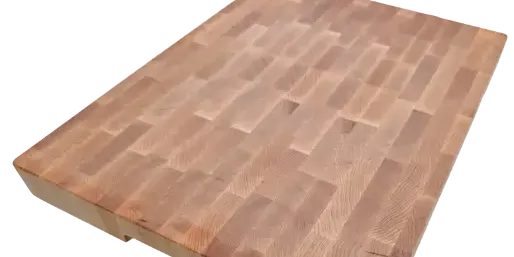
In the kitchen this is the whole story. A thin beech board that is washed under the hot tap, left to drain on one side and then propped by the cooker will cup within weeks, and if it is held flat by a frame or a set of feet it will split instead. The same wood in a thick block, dried slowly to 6 to 8 per cent moisture, glued up as end grain with the blocks alternating, and oiled regularly, behaves very well. That is how French butchers have used it for two hundred years. It is the board, not the wood, that usually fails.
| Wood | Radial | Tangential | Volumetric | T/R ratio | What it means |
|---|---|---|---|---|---|
| Black walnut Juglans nigra |
5.5% | 7.8% | 12.8% | 1.4 | Very stable. |
| Black cherry Prunus serotina |
3.7% | 7.1% | 11.5% | 1.9 | Good. |
| Hard maple Acer saccharum |
4.8% | 9.9% | 14.7% | 2.1 | Moderate. Stable once dried and glued up as end grain. |
| European beech Fagus sylvatica |
5.8% | 11.7% | 17.9% | 2.0 | Moves a lot in service. Thick end grain only. |
| American beech Fagus grandifolia |
5.5% | 11.9% | 17.2% | 2.2 | Moves a lot in service. |
How hard is beech? The Janka test
Hardness is measured by pressing a steel ball 11.28 mm across into a block of dry wood until it has sunk to half its diameter, and recording the force in pounds-force (lbf). European beech needs 1,450 lbf on the side grain, the same figure as hard maple to the pound; American beech is a little softer at 1,300. On the end grain the USDA measured American beech at 1,590 lbf. Beech is hard enough to take a cleaver and soft enough to spare a knife, and it is the reason European butchers never felt the need for maple.
Pores and hygiene
Hardwoods carry water up the trunk in vessels, which appear on the end grain as pores. Beech is diffuse-porous, like maple: its vessels are small, numerous and scattered evenly through each year’s growth, with none of the open spring bands that make oak and ash poor end-grain boards. On the end grain a beech block is nearly as tight as a maple one. It is a clean, dense surface that dries quickly and gives bacteria nowhere to settle, which is why European health inspectors have accepted beech blocks in butchers’ shops for generations.
What beech has that maple does not is rays. Every hardwood has rays, ribbons of cells running from the centre of the trunk outwards, but beech’s are unusually wide, and on a quarter-sawn face they show as a scatter of small silvery flecks across the grain. They are harmless and rather pretty, and they are the surest way to tell a beech board from a maple one.
Is beech poisonous?
No. Beech is probably the most-used food-contact wood on Earth. It has no toxins, almost no tannin, no silica and no resin, and it imparts no taste, which is why it is the wood of spoons, spatulas and rolling pins, and why generations of French, German and Italian butchers have chopped on it. Beech mast is edible in small quantities, and beech leaves were once used to stuff mattresses. The one hazard is for the trade: beech dust is a recognised cause of nasal cancer in people who breathed it for years in furniture factories, and modern workshops extract it at source. It has no bearing on a finished board.
Silica, resin and knives
Beech has neither silica nor resin, so it will not abrade a knife edge, and at maple’s hardness it is firm enough to resist scoring without being hard on steel. On a side-grain board it wears cleanly. On end grain the fibres part around the blade and close again, as maple’s do. There is nothing to fault here.
Steamed beech: why it is pink
Much of the European beech on the market has been steamed at the mill. Fresh beech is a pale cream, but the trade prefers a uniform colour, and steaming the boards before drying turns them an even pinkish brown and relieves some of the stresses in the wood. It also makes the wood slightly softer and, according to most woodworkers, no more stable. Unsteamed beech is paler and a little harder. Either makes a board; neither changes the fact that the wood moves.
Is beech sustainable?
Yes, and with a long record. European beech is the dominant hardwood of managed forests across Germany, France, Austria and the Balkans, where it has been harvested on rotation for centuries, and it is one of the easiest hardwoods to buy with FSC or PEFC certification. It is listed as a species of least concern. American beech is equally common in the eastern United States, though it is under attack from beech bark disease and a newer beech leaf disease, which is one of the reasons the American timber trade has never valued it as highly.
Five things you did not know about beech
- You are reading one. The word “book” descends from the Old English bōc, beech, because early runes were scratched onto beech tablets. German has the same pair: Buche and Buch.
- Fifty million chairs. Michael Thonet’s No. 14 café chair of 1859, six steam-bent beech rods and ten screws, was the first mass-produced piece of furniture. It shipped flat in boxes of thirty-six.
- It made the beer. Budweiser is still “beechwood aged”: strips of beech in the lagering tanks give the yeast something to settle on. It adds no flavour, which is arguably the point.
- Pigs were fattened on it. Pannage, the right to turn pigs into the woods to eat beech mast and acorns in autumn, was written into the Domesday Book and is still practised in the New Forest.
- It is the smoothest bark in the forest. Beech bark stays thin and smooth for the tree’s whole life, which is why it is the tree that lovers carve their initials into, and why the initials are still legible a century later.
Head to head
Beech against the woods we use
Side by side, beech is maple’s equal on hardness and pore structure, and cheaper. It loses on stability and rot resistance, and those are the two things that decide whether a block lasts.
| Wood | Janka side grain |
Janka end grain |
Density kg/m³ |
Pores | Volumetric shrinkage | T/R ratio | Rot resistance |
|---|---|---|---|---|---|---|---|
| European beech Fagus sylvatica |
1,450 lbf | 1,590 lbf* | 710 | Diffuse porous | 17.9% | 2.0 | Perishable |
| Hard maple Acer saccharum |
1,450 lbf | 1,846 lbf | 705 | Diffuse porous | 14.7% | 2.1 | Non-durable |
| Black walnut Juglans nigra |
1,010 lbf | 1,850 lbf | 610 | Semi-ring porous | 12.8% | 1.4 | Very durable |
| Acacia Acacia mangium |
1,430 lbf | not published | 585 | Diffuse porous | 10.7% | 2.8 | Moderate |
* End-grain figure measured on American beech, the closest tested species.
Our verdict
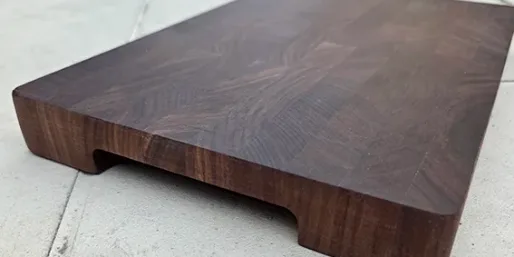
Buy beech for spoons, rolling pins and a cheap, hard everyday board, and buy it thick. Dry it standing up, oil it often and keep it away from the radiator, and it will serve well. Do not expect a thin beech board to stay flat, because it will not. For a butcher’s block that will stay flat and clean for decades without being nursed, we build in maple, which has beech’s hardness and pore structure with a good deal less of its temperament, and in walnut, which has almost none of it.
Sources: Hardness, density and shrinkage figures from The Wood Database entries for European beech, American beech, hard maple, black walnut, black cherry and mangium. End-grain hardness from USDA Technical Bulletin 479 (Markwardt & Wilson, 1935). Thonet production figures from the Vitra Design Museum. Back to all chopping board materials.