The short version
Bamboo is the most popular chopping board material in the world, and the one we would least like to cut on. The plant is a marvel: a grass that grows a metre a day, harvests in five years and regrows from its roots. The board is another matter. It is a panel of small glued strips, each with a skin of silica-laden bark on it, and silica is what sand and glass are made of. It blunts knives faster than any hardwood, it comes apart in the dishwasher, and the glue that holds it together is the largest single ingredient. Bamboo is a better board than plastic or glass. It is not a better board than wood.
What bamboo gets right
- Hard: 1,410 to 1,610 lbf, level with or above hard maple.
- Extraordinarily renewable as a plant: harvested at four to six years, regrows without replanting.
- Light, cheap and uniform, with no knots, sapwood or figure to sort.
- Not toxic in itself, and rated non-porous: there are no vessels to hold liquid.
- A great deal better than plastic, glass, marble or steel.
Where it falls short
- Silica in the skin, 0.5 to 4 per cent, works like fine sandpaper on a knife edge.
- Made entirely of glued strips; the glue fails in hot water and the board splits or delaminates.
- Usually bonded with urea-formaldehyde resin; emissions depend on the factory.
- Splinters as the surface wears through the skin of the strips.
- The green claim covers the plant, not the energy, resin and shipping that make the board.
- Janka hardness
- 1,410–1,610 lbfnatural bamboo, side grain
- Density
- 500–850 kg/m³varies with species and processing
- Pore structure
- Nonea grass: fibre bundles, no vessels, no rays
- Poisonous
- Nothe plant is not; check the glue
- Silica
- 0.5–4%in the outer skin of the stem
- Kind to knives
- Nosilica abrades the edge
- Stability
- Poor when wetglue lines fail; 10–16% shrinkage in the stem
- Cloumann grade
- Fwe would not cut on it
What is bamboo, exactly?
Bamboo is a grass. It belongs to the same family as wheat, rice and the lawn, and that is not a technicality but the key to everything on this page. There are well over a thousand species, from dwarf garden bamboos to giants thirty metres tall, and the ones that become chopping boards are mostly moso, Phyllostachys edulis, grown across southern China. A moso shoot emerges from the ground in spring at its full final diameter and simply gets taller, up to a metre a day at its peak, reaching full height in a couple of months. It then spends four or five years hardening before it is cut.
Because it is a grass, bamboo has none of the things that make a wood a wood. There is no heartwood and no sapwood, no growth rings, no rays and no vessels. The stem, called a culm, is a hollow tube divided by solid walls at the nodes, and the wall of the tube is a bundle of long fibres held in a soft matrix, denser towards the outside. The outer skin is where the plant stores its silica, and the outer skin is where the strength is. That combination is the whole story of bamboo as a board material.
How a hollow tube becomes a flat board
You cannot cut a plank from a pipe. To make a board, the culm is split lengthways into strips, the nodes are cut out, the strips are boiled to remove sugars and starch (which would otherwise attract insects and mould), sometimes steamed under pressure to caramelise them to a darker colour, dried, planed into small rectangles and then glued together in a press. There are three ways to glue them. Laid flat, the strips show their broad face and the nodes appear as the familiar dark bands. Stood on edge, they show their narrow face and the board looks striped. Or the strips are crushed into fibres, soaked in resin and compressed into a dense block called strand-woven bamboo, which is very hard indeed and is mostly used for flooring.
Whichever way, the finished board is between a tenth and a fifth adhesive by weight, and every cutting surface is a patchwork of dozens of glue lines. That is where bamboo boards fail. Water gets into the joints, the strips swell at different rates, and the board splits or lifts along a line. A dishwasher does it in weeks.
Silica: why bamboo blunts knives
Grasses have a habit that trees do not. They take up silica from the soil and deposit it in their tissues as microscopic glassy bodies called phytoliths, partly to make themselves unpalatable to grazing animals. It works: the teeth of horses and cattle are worn down by it over a lifetime. Bamboo does the same, and concentrates the silica in the outer skin of the culm, where it can make up as much as four per cent of the weight. Silica is silicon dioxide, the mineral in sand, quartz and glass, and it is far harder than steel.
A bamboo board is made from strips that each carry a slice of that skin, and the knife runs across them with every cut. The effect is a fine abrasive, exactly like drawing the blade across a strip of very fine sandpaper. The Wood Database advises woodworkers to use carbide-tipped tools on bamboo because ordinary steel blades dull quickly. A kitchen knife has no such option. This is the single reason that people who care about their knives do not cut on bamboo, and it has nothing to do with hardness.
How hard is bamboo? The Janka test
Hardness is measured by pressing a steel ball 11.28 mm across into a block of dry material until it has sunk to half its diameter, and recording the force in pounds-force (lbf). Natural bamboo tests between 1,410 and 1,610 lbf depending on species and density, which puts it level with hard maple or a little above it. Carbonised bamboo, the darker sort, is softer, because the steaming that colours it weakens the fibres. Strand-woven bamboo is far harder than any of them. So the sales pitch that bamboo is “harder than maple” is true and beside the point. Hardness was never the problem.
A note on end grain. Our materials page quotes end-grain hardness figures where the USDA measured them, and lists bamboo at around 2,000 lbf on that basis. Bamboo has no true end grain, since it has no vessels, but the fibre ends are extremely hard. It makes no difference to the silica.
Is bamboo safe for food?
The plant is entirely safe. The question is the glue. A bamboo board is bonded with a synthetic resin, most often urea-formaldehyde, which gives off formaldehyde gas as it ages. How much depends on the resin and on the factory’s process, and the better makers test to the European E1 standard or the stricter Californian CARB Phase 2 limit. The worst do not test at all, and a cheap board can smell of it out of the box. The resin is not on the cutting surface in any quantity and the risk from a single board in a ventilated kitchen is small, but it is a question that a solid hardwood board, glued in a handful of joints with a food-safe PVA adhesive, does not raise.
Bamboo dust can irritate the skin of the people who process it, as most plant dusts can. It has no bearing on a finished board.
Splinters, dishwashers and the life of a bamboo board
A new bamboo board is smooth because each strip still has its skin. As the knife wears through the skin it reaches the softer, spongier fibre beneath, which frays and lifts. Owners of older bamboo boards know the fine splinters. Meanwhile water is working on the glue lines, and hot water works faster: the strips swell at different rates, the joints let go and the board splits. A bamboo board that is washed by hand, dried on edge and oiled monthly can last some years. One that goes through the dishwasher rarely lasts a season. Neither can be resurfaced more than once or twice, because the strips are thin.
Is bamboo really sustainable?
The plant deserves its reputation. Moso is harvested at four to six years old, it regrows from the same root system without replanting, it needs no pesticides and it fixes carbon quickly on hillsides too steep to farm. Compared with a hardwood tree that takes sixty to a hundred years to reach sawlog size, it is a miracle of renewal.
The board is less of a miracle. Turning a hollow grass stem into a flat panel takes boiling, steaming, drying, planing, a great deal of resin and a hot press, and nearly all of it happens in China before the board is shipped to Europe. Then it lasts a few years and goes in the bin. A hardwood board from a certified forest that is used for thirty years and can be sanded flat a dozen times has a smaller footprint over its life, even before you count the knives it did not blunt. Sustainability is a sum, not a slogan, and the plant is only the first term in it.
Five things you did not know about bamboo
- It is the fastest-growing plant on Earth. Some species have been measured growing close to a metre in twenty-four hours. A moso shoot reaches its full height in eight to ten weeks and then never grows another centimetre.
- It flowers once and dies. Many bamboos flower only every few decades, and when they do every plant of that species flowers at once, wherever it is in the world, and then dies. Nobody knows how they keep time.
- Edison used it. The filament in Thomas Edison’s first commercially successful light bulb was carbonised bamboo, which outlasted every other material he tried.
- It is stronger than steel, by weight. Bamboo’s tensile strength is higher than mild steel’s for the same weight, which is why it still scaffolds skyscrapers in Hong Kong.
- The pandas are picky. A giant panda eats twelve to thirty-eight kilograms of bamboo a day and digests almost none of it. It has the gut of a carnivore and the diet of a lawnmower.
Head to head
Bamboo against the woods we use
Side by side, bamboo wins on price and renewability of the raw material and loses on everything a knife cares about.
| Material | Janka side grain |
Density kg/m³ |
Structure | Silica | Glue in board | Dishwasher | Kind to knives |
|---|---|---|---|---|---|---|---|
| Bamboo Phyllostachys edulis |
1,410–1,610 lbf | 500–850 | Grass, glued strips | 0.5–4% | 10 to 20% by weight | No | No |
| Hard maple Acer saccharum |
1,450 lbf | 705 | Diffuse-porous hardwood | None | Joints only | No | Yes |
| Black walnut Juglans nigra |
1,010 lbf | 610 | Semi-ring-porous hardwood | None | Joints only | No | Yes |
| Acacia Acacia mangium |
1,430 lbf | 585 | Diffuse-porous hardwood | None | Many joints | No | Yes |
Our verdict
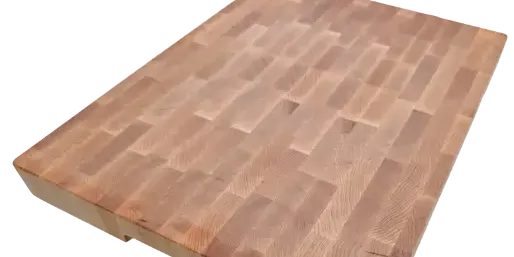
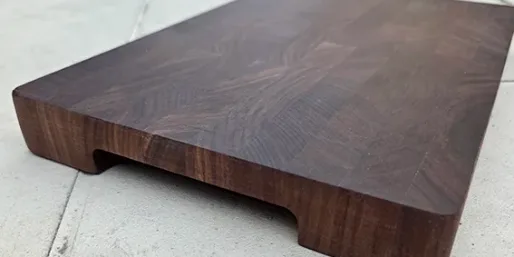
If the choice is between bamboo and plastic, glass, marble or steel, buy the bamboo: it is the only natural material on that list and by far the least brutal. If the choice includes wood, buy the wood. A bamboo board will blunt a good knife in months, will not survive a dishwasher, and will be in a bin within a few years. An end-grain maple or walnut board that is oiled now and then will outlive the kitchen it was bought for.
Sources: Hardness, density, silica content and processing notes from The Wood Database entry for bamboo; hardwood figures from its entries for hard maple, black walnut, black cherry, white oak, mangium and black locust. Phytolith chemistry from the Royal Botanic Gardens, Kew. Formaldehyde standards from the European Committee for Standardization (EN 13986) and the California Air Resources Board. Back to all chopping board materials.