The short version
Ash is a good, honest, hard-working wood that makes a decent chopping board and a demanding butcher’s block. It is as hard as maple, tougher than almost anything, pale and clean, cheap, non-toxic, free of silica and, unlike oak, nearly free of tannin, so it does not stain. Its one flaw is the same as oak’s: it is ring-porous, and on the end grain its big spring vessels are open holes. Ash plugs more of them than oak does, so an end-grain ash block can work, but it asks for more careful drying and more frequent oiling than a maple or walnut one. It is a good board that needs a good owner.
What ash gets right
- Hardness right in the sweet spot: 1,480 lbf for European ash, 1,320 for American white ash, 1,720 on the end grain.
- Exceptionally tough and springy. It does not split or splinter.
- Not poisonous, no silica, no resin, and almost no tannin, so no black marks.
- Pale and even, with an attractive bold grain; olive ash has dark streaks.
- Cheap and, at the moment, very plentiful.
Where it falls short
- Ring-porous: open spring vessels on the end grain hold water and food residue.
- Rated perishable against rot; a wet ash board goes grey and soft.
- Coarse texture that shows knife wear on a side-grain board.
- The reason it is cheap is that the trees are dying: ash borer in America, dieback in Europe.
- Some people find the smell of freshly worked ash unpleasant. It fades.
- Janka hardness
- 1,720 lbfend grain (USDA, white ash); 1,320–1,480 lbf side grain
- Density
- 675–680 kg/m³air dry, white and European ash
- Pore structure
- Ring poroustyloses common
- Poisonous
- Noand almost no tannin
- Silica
- Noneno resin either
- Kind to knives
- Yeshard but not abrasive
- Stability
- GoodT/R shrinkage ratio 1.6–1.7
- Cloumann grade
- Bgood, if you look after it
What is ash, exactly?
Ash is the genus Fraxinus, about sixty species of trees in the olive family, which makes it a surprising cousin of the olive, the lilac and the jasmine. Two of them make boards. European ash, Fraxinus excelsior, is one of the commonest trees in Britain, the tall grey-barked tree of hedgerows and hillsides with black buds in winter and bunches of keys in autumn. American white ash, Fraxinus americana, is its counterpart across the Atlantic, a little softer and the wood of every baseball bat until maple took over. The timber of the two is near enough identical.
Ash was the working wood of Europe long before it was a kitchen one. It is tough and elastic in a way that harder woods are not: it bends before it breaks, and it takes a shock that would shatter oak. That made it the wood of spear shafts, cart axles, wheel rims, ladder rungs, hockey sticks, tennis rackets, tool handles and the frames of Morgan sports cars, which are still built on an ash skeleton today.
Pores: the good news and the bad
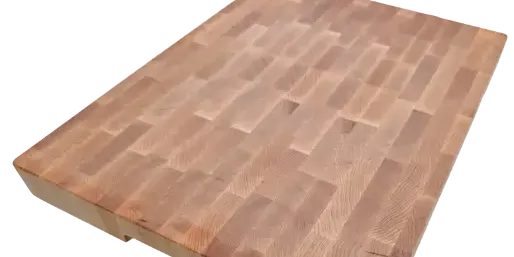
Hardwoods carry water up the trunk in vessels, which appear on the end grain as pores. Ash, like oak, is ring-porous: each spring the tree lays down a band of very large vessels two to four rows deep, followed by summer wood of small pores and dense fibre. That is what gives ash its bold, oak-like grain, and it is the bad news for an end-grain board, because every spring vessel is an open tube pointing up at the food.
The good news is what ash does with its old tubes. The vessels are commonly blocked by tyloses, balloon-like growths that the tree uses to seal off plumbing it no longer needs, and ash has far less tannin than oak, so the moisture that does get in does not turn the wood black around a knife. An end-grain ash block is not as tight as maple, but it is not the bacteria hotel that red oak is. It needs to be dried standing up after washing, and oiled more often, and in return it is hard, cheap and handsome. That is why we mark it B where we mark oak D.
How hard is ash? The Janka test
Hardness is measured by pressing a steel ball 11.28 mm across into a block of dry wood until it has sunk to half its diameter, and recording the force in pounds-force (lbf). European ash needs 1,480 lbf on the side grain and American white ash 1,320, bracketing hard maple at 1,450. On the end grain, the surface your knife meets on a butcher’s block, the USDA measured white ash at 1,720 lbf. Ash is, if anything, a little firmer than maple, and much springier: its strength for its weight is among the best of any temperate hardwood.
Is ash poisonous?
No. Ash contains no toxins and, unlike its look-alike oak, very little tannin, so it neither poisons nor stains. It has been carved into bowls and spoons across Europe for as long as people have had knives, and in Norse mythology the first man was made from an ash tree. The dust of freshly worked ash has a smell that some woodworkers find unpleasant and can irritate the lungs, which is a workshop matter. A finished, oiled board has no smell at all.
Silica, resin and knives
Ash has neither silica nor resin, so it will not abrade a knife edge the way bamboo does, and its hardness sits squarely in the range that suits a blade. It is a coarse-textured wood, though, and on a side-grain board that coarseness shows wear sooner than a fine-grained wood like maple would. On end grain the fibres part around the knife and the wear is far less visible.
Movement and stability
Wood shrinks as it dries and swells as it gets wet, more around the growth rings than across them. Ash is well behaved: a ratio of 1.6 for white ash and 1.7 for European, better than maple or beech and not far off walnut. A properly dried ash board stays flat. The weakness is not movement but rot: ash heartwood is rated perishable, and a board left wet turns grey and spongy faster than maple. Keep it dry and oiled and it lasts; leave it in the sink and it does not.
| Wood | Radial | Tangential | T/R ratio | What it means |
|---|---|---|---|---|
| Black walnut Juglans nigra |
5.5% | 7.8% | 1.4 | Very stable. |
| White ash Fraxinus americana |
4.9% | 7.8% | 1.6 | Stable. |
| European ash Fraxinus excelsior |
5.7% | 9.6% | 1.7 | Stable, with higher total shrinkage. |
| White oak Quercus alba |
5.6% | 10.5% | 1.9 | Moderate. Flat-sawn boards cup. |
| Hard maple Acer saccharum |
4.8% | 9.9% | 2.1 | Moderate. Stable once dried and glued up as end grain. |
A tree in trouble
There is a reason ash is cheap and plentiful just now, and it is not a happy one. In North America the emerald ash borer, a small metallic-green beetle from north-east Asia, was found in Michigan in 2002, probably having arrived in packing timber. Its larvae tunnel under the bark and cut off the tree’s water supply, and it kills almost every ash it reaches within a few years. It has now killed hundreds of millions of trees, and the IUCN lists American white ash as critically endangered.
Britain and Europe have a different enemy with the same result. Ash dieback is a fungus, also from Asia, that arrived in Europe in the 1990s and in Britain in 2012. It kills the leaves and then the branches, and the Forestry Commission expects it to kill the great majority of Britain’s ash trees over the coming decades. Landowners are felling infected trees in enormous numbers, and that timber is coming to market. Using it is better than burning it. But it is not a wood with a long future in the volumes the trade is used to, and a board bought today is a small piece of a tree that is disappearing.
Is ash sustainable?
It is complicated. The trees are dying from pests and disease, not from logging, and there is a strong case for using the timber from felled trees rather than letting it rot or burning it. But American white ash is officially critically endangered, European ash is heading the same way, and neither can be replanted with any confidence until resistant strains are found. If you like ash, buy it from a certified source and enjoy it. Just do not assume you will be able to buy it in twenty years.
Five things you did not know about ash
- The world tree was an ash. In Norse mythology Yggdrasil, the tree that holds up the nine worlds, is an ash, and the first man, Ask, was carved from one.
- It built the first cars. Before pressed steel, car bodies were ash frames with metal panels tacked on, and Morgan in Malvern still builds every car that way.
- Baseball switched sides. Ash was the bat wood for a century until Barry Bonds hit seventy-three home runs with a maple bat in 2001; ash bats flake, maple ones shatter, and the argument continues.
- The keys are edible. Young green ash keys were pickled in seventeenth-century England and served like capers. Nobody has revived the fashion.
- It burns green. Ash is the one firewood that burns well straight from the tree, because its moisture content when felled is unusually low. Every old rhyme about firewood says so.
Head to head
Ash against the woods we use
Side by side, ash matches maple for hardness and beats it for toughness and price. It loses on pores, and on the future of the tree.
| Wood | Janka side grain |
Janka end grain |
Density kg/m³ |
Pores | T/R ratio | Tannin | Silica |
|---|---|---|---|---|---|---|---|
| European ash Fraxinus excelsior |
1,480 lbf | 1,720 lbf* | 680 | Ring porous | 1.7 | Low | None |
| Hard maple Acer saccharum |
1,450 lbf | 1,846 lbf | 705 | Diffuse porous | 2.1 | Low | None |
| Black walnut Juglans nigra |
1,010 lbf | 1,850 lbf | 610 | Semi-ring porous | 1.4 | Low | None |
| White oak Quercus alba |
1,350 lbf | 1,524 lbf | 755 | Ring porous | 1.9 | High | None |
* End-grain figure measured on American white ash, the closest tested species.
Our verdict
Ash makes a good side-grain board and an acceptable end-grain one for an owner who will dry it standing up and oil it every few weeks. It is hard, tough, clean and cheap, and it does not stain. If you have a piece of a felled ash tree and want it made into something useful, a board is a fine choice. For a butcher’s block that will forgive neglect and stay clean without thought, we build in maple and walnut, whose end grain is closed where ash’s is open.
Sources: Hardness, density and shrinkage figures from The Wood Database entries for white ash, European ash, hard maple, black walnut, white oak and black locust. End-grain hardness from USDA Technical Bulletin 479 (Markwardt & Wilson, 1935). Emerald ash borer and IUCN status from the USDA Forest Service and the IUCN Red List; ash dieback from Forest Research and the Forestry Commission. Back to all chopping board materials.