The short version
Acacia is a perfectly respectable chopping board wood, and a far better buy than bamboo, glass or plastic. The good ones are about as hard as maple, kind to knives, closed-grained and free of silica. The catch is that “acacia” is not one wood. It is a label covering more than a thousand species, and the boards in most shops are fast-grown plantation timber, glued up from small side-grain offcuts. That is why they are cheap, and why some of them warp.
What acacia gets right
- Hardness in the sweet spot: about 1,430 lbf for the common species, almost identical to hard maple.
- Diffuse-porous, so none of the open vessels that make oak a poor board.
- Not poisonous, no silica, no resin. Safe for food once oiled.
- Fast-growing plantation timber, often FSC-certified, and inexpensive.
- Warm golden-brown colour with dramatic dark streaks.
Where it falls short
- You rarely know which species you are buying, or how old the tree was.
- Shrinks nearly three times as much across the rings as through them, so it cups more readily than maple or walnut.
- Almost always side-grain and finger-jointed, so knife scoring shows and glue lines can open.
- Young plantation wood is lighter and softer than the textbook numbers.
- The even colour is often stain, and it wears off where you cut.
- Janka hardness
- 1,430 lbf6,340 N, side grain, Acacia mangium
- Density
- 585 kg/m³air dry; varies with tree age
- Pore structure
- Diffuse porouslarge but few vessels
- Poisonous
- Noplantation species are food-safe
- Silica
- None reportedash content about 0.2%
- Kind to knives
- Yesno silica, no resin
- Stability
- ModerateT/R shrinkage ratio 2.8
- Typical build
- Side grainglued strips, 15 to 20 mm thick
What is acacia, exactly?
Acacia is a genus in the pea family, which makes it a cousin of beans, clover and gorse. Like most legumes it fixes its own nitrogen through bacteria in its roots, which is one reason it grows so fast on poor soil. There are well over a thousand species. In Australia, where most of them live, they are called wattles, and the golden wattle is the national floral emblem.
The tree most people picture when they hear the word is the flat-topped thorn tree of the African savanna, with a giraffe reaching into it. Since 2005 that tree is not an acacia at all. At the International Botanical Congress in Vienna, botanists voted by a narrow margin to keep the name Acacia for the thousand or so Australian species and to rename the African and American thorn trees Vachellia and Senegalia. African botanists were not pleased, and the argument rumbled on for years.
Then there is the acacia that was never an acacia. Across Europe, “acacia” garden furniture and “acacia honey” come from Robinia pseudoacacia, the black locust, a North American tree whose Latin name literally means false acacia. It is a fine, tough timber, but as we will see, it is built quite differently inside.
One more oddity that woodworkers enjoy. Most Australian acacias abandon true leaves as they grow up. The seedling has feathery, fern-like leaves, but the adult tree replaces them with phyllodes: flattened leaf stalks that do the job of a leaf. On Acacia mangium they can be the length of your forearm.
Which acacia is in your chopping board?
Almost certainly Acacia mangium, Acacia auriculiformis or a hybrid of the two. Both are native to northern Australia and New Guinea, but the timber in your board grew in a plantation in Vietnam, Indonesia, Malaysia or Thailand. Vietnam alone has hundreds of thousands of hectares of it. The trees are planted for pulp on a rotation of five to eight years, and for sawlogs a few years longer. That is astonishingly fast for a hardwood. A hard maple destined for a butcher’s block is typically sixty to a hundred years old when it is felled.
Speed has a cost. A tree that reaches sawlog size in a decade is mostly juvenile wood: wide growth rings, a big proportion of pith, lower density and more tendency to move. The Wood Database notes that mangium’s density is “variable based on age and growing conditions”, which is a polite way of saying that two acacia boards from the same shelf can be quite different woods.
Two other acacias turn up in the timber trade. Australian blackwood (Acacia melanoxylon) and Hawaiian koa (Acacia koa) are beautiful, expensive cabinet and instrument woods. You will find them in guitars and ukuleles. You will not find them in a £15 chopping board.
How hard is acacia? The Janka test
Wood hardness is measured with a brutally simple test. A steel ball 11.28 mm across is pressed into a block of dry wood until it has sunk to half its diameter, and the force needed is recorded in pounds-force (lbf) or newtons. Soft balsa needs about 90 lbf. Lignum vitae, the hardest trade timber, needs over 4,000.
On this scale Acacia mangium tests at 1,430 lbf, within a whisker of hard maple at 1,450. That is the single best argument for acacia. It sits comfortably in the range where a board is firm enough to resist scoring yet soft enough to spare the edge of a knife. The other acacias spread out on either side, which is why you will see wildly different “acacia hardness” numbers online. Whoever wrote them was thinking of a different tree.
A note on end grain. Every Janka figure you will find online, including these, is measured on the side of the plank. On an end-grain board the knife meets the ends of the fibres, and end-grain hardness is always higher, by anything from ten to eighty per cent in the USDA tests of American woods. Nobody has published an end-grain figure for plantation acacia, so we quote side grain here and side grain for the comparison woods. The table on our materials page uses end-grain figures where they exist.
Pores and hygiene
A hardwood carries water up the trunk through vessels, which show on the end grain as pores. How those pores are arranged matters more for a chopping board than almost anything else, because open pores on the cutting surface hold water, juice and bacteria.
Acacia is diffuse-porous. Its vessels are large but few, scattered fairly evenly through each year’s growth, with a sheath of soft tissue around each one. That is the same family of structure as maple, cherry and walnut, and it is good news. There are no bands of gaping earlywood vessels to trap moisture. The pores are bigger than maple’s, so an end-grain acacia surface is a touch more open, but it is nothing like oak.
Black locust, the false acacia, is the opposite: ring-porous, with rows of large vessels along each growth ring, exactly like oak and ash. Nature plugs most of them with balloon-like growths called tyloses, which is why locust fence posts last for decades in the ground. It is still not a structure we would want under a knife.
Is acacia poisonous?
No. The plantation acacias have no known toxicity beyond the dust irritation that comes with sanding any wood, and once the board is oiled it is safe for food. The old woodworker’s rule of thumb is that a tree with an edible seed is a safe tree, and the seeds of many Australian acacias have been eaten for tens of thousands of years. Roasted and ground, wattleseed tastes of coffee and hazelnut, and you can buy it as a flour.
Two caveats. Australian blackwood is a known sensitiser for the people who mill and sand it, though not for the people who eat off it. And black locust is genuinely poisonous: its bark, leaves and seeds contain a toxic protein that has poisoned horses and hospitalised children who chewed the bark. The dried timber is not regarded as a hazard, and it has been used for barrels and furniture for centuries, but it would not be our first choice of wood to chop an onion on.
Silica and resin
The two things that really ruin a knife edge are silica and resin. Silica is the grit that makes bamboo and teak so hard on tools. Acacia has none worth mentioning: the whole mineral content of mangium wood, measured as ash, is about 0.2 per cent, and none of it shows up as silica in the literature. Nor does acacia have resin canals. It is not a resinous or oily wood in the way that teak or olive is.
That surprises people, because acacia boards are sold as “naturally water-resistant thanks to the wood’s natural oils”. The plantation species are moderately durable at best. The water resistance you see in the shop comes from the factory’s oil or lacquer, and it needs topping up like any other board.
Is acacia good for knives?
Yes. It has the hardness of maple and no abrasive in the grain, so it will not blunt a good blade any faster than maple does. The one difference is the way the boards are built. Nearly every acacia board is side grain, so the knife cuts across the fibres rather than slipping between them. Scoring shows sooner, and a well-used side-grain board will look tired long before an end-grain one. Some acacias also have interlocked grain, which can lift in small fibres where the knife has been.
Movement and stability: the real weakness
Wood shrinks as it dries and swells as it gets wet, but not evenly. It moves most around the growth rings (tangentially) and less across them (radially). The ratio between the two tells you how much a board wants to cup. A ratio near 1 is a calm, stable wood. Above 2 it needs careful handling.
| Wood | Radial | Tangential | T/R ratio | What it means |
|---|---|---|---|---|
| Acacia mangium Acacia mangium |
2.8% | 7.8% | 2.8 | Cups readily. Needs thick stock and even drying. |
| Australian blackwood Acacia melanoxylon |
3.9% | 7.9% | 2.0 | Moderate. |
| Hard maple Acer saccharum |
4.8% | 9.9% | 2.1 | Moderate. Stable once dried to 6 to 8% and glued up as end grain. |
| Black walnut Juglans nigra |
5.5% | 7.8% | 1.4 | Very stable. One of the calmest cabinet woods. |
| Black locust Robinia pseudoacacia |
4.6% | 7.2% | 1.6 | Stable, but ring porous. |
Mangium’s ratio of 2.8 is the highest of any wood we have looked at for a board. Add juvenile wood, thin strips and a trip through the dishwasher and you have the classic acacia complaint: a board that arrived flat and rocks on the worktop six months later. It is not that acacia is a bad wood. It is that it is an unforgiving wood, and it is being used in the thinnest, cheapest way possible.
How acacia boards are made
Plantation trees are small, so the sawmill gets short, narrow boards out of them. To make a chopping board those pieces are finger-jointed end to end, glued edge to edge into a panel, planed to 15 or 20 mm and cut to size. The striking dark and light stripes you see are partly the natural contrast between heartwood and sapwood, and partly a stain applied to make a batch of mismatched offcuts look like one piece of wood. Look at a well-used acacia board and you will often see the stain worn through in the middle.
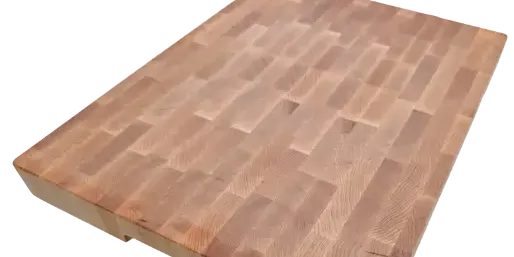
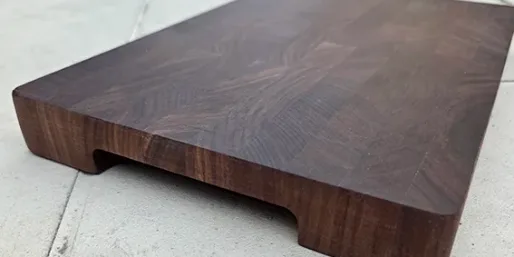
End-grain acacia boards exist, but they are rare and usually small, because the wood’s movement makes a large end-grain panel risky. Every Cloumann board is end grain, 40 mm thick, from maple or walnut that has been kiln-dried and rested before it is cut, precisely because we want a board that stays flat for decades.
Is acacia sustainable?
Here acacia has a genuinely good story to tell, with a footnote. A tree that reaches harvest in under a decade, fixes its own nitrogen and grows on degraded land is about as renewable as timber gets. Vietnam has more than half a million hectares of FSC-certified plantation forest, much of it acacia, and it is not hard to find certified acacia boards. Nothing has to be felled from a natural forest to make one.
The footnote is that acacia plantations do not always replace degraded land. In Sumatra and Borneo, vast mangium plantations for pulp were established on cleared rainforest and drained peat, and Acacia mangium has become invasive in parts of the tropics where it was introduced. The species is not the problem; the plantation’s history is. As with any wood, ask for the certificate rather than the adjective.
What does acacia look like?
The heartwood ranges from pale gold to a deep coffee brown, often in the same board, with darker streaks that follow the grain. The sapwood is a creamy yellow and the contrast between the two is sharp, which is what gives acacia boards their busy, striped look. The grain is straight to slightly interlocked with a medium texture. Like most tropical hardwoods it darkens with light and age, and the golden tones warm towards brown.
If you like the look, you like it. It photographs beautifully and it hides stains well. If you prefer the quieter, more even figure of a single piece of wood, maple or walnut will suit you better.
Five things you did not know about acacia
- You have probably eaten it. Gum arabic, the emulsifier in fizzy drinks, wine gums and watercolour paint, is dried sap from two African acacias, now called Senegalia senegal and Vachellia seyal.
- It has bodyguards. The bullhorn acacia of Central America grows hollow thorns for ants to live in and feeds them nectar and protein. In return the ants attack anything that touches the tree, including other plants.
- It is in the Bible. The Ark of the Covenant was built of shittim wood, which scholars identify as an acacia of the Sinai desert.
- It makes ukuleles. Hawaiian koa is an acacia, prized for the way it sings, and koa canoes carried Polynesians across the Pacific.
- The false one glows. Black locust heartwood fluoresces a vivid yellow-green under ultraviolet light, a party trick that woodworkers use to tell it apart from mulberry.
Head to head
Acacia against the woods we use
Side by side, the case for acacia is hardness and price. The case against is consistency and stability.
| Wood | Janka side grain |
Density kg/m³ |
Pores | T/R ratio | Poisonous | Silica | Typical board |
|---|---|---|---|---|---|---|---|
| Acacia Acacia mangium |
1,430 lbf | 585 | Diffuse porous | 2.8 | No | None | Side grain, 15 to 20 mm, stained |
| Hard maple Acer saccharum |
1,450 lbf | 705 | Diffuse porous | 2.1 | No | None | End grain, 40 mm (Cloumann) |
| Black walnut Juglans nigra |
1,010 lbf | 610 | Semi-ring porous | 1.4 | No | None | End grain, 40 mm (Cloumann) |
| Black locust (“false acacia”) Robinia pseudoacacia |
1,700 lbf | 770 | Ring porous | 1.6 | Bark and leaves | None | Rarely made into boards |
Our verdict
Buy an acacia board if you want an inexpensive everyday board or a handsome serving board, and you are prepared to wash it by hand and oil it. Choose a thick one, look for an FSC label, and expect to replace it in a few years. It will treat your knives well.
Do not expect it to be an heirloom. We make our boards from mature, kiln-dried maple and walnut because we want them to stay flat and be handed down, and acacia in the form it is usually sold cannot promise that. If that is what you are after, have a look at the boards below.
Sources: Hardness, density and shrinkage figures from The Wood Database entries for mangium, Australian blackwood, koa, black locust, hard maple and black walnut. End-grain hardness ratios from USDA Technical Bulletin 479 (Markwardt & Wilson, 1935). Plantation rotation and hybrid data from Annals of Forest Science (2019) and the Vietnam Journal of Science, Technology and Engineering (2017). Genus revision from the International Botanical Congress, Vienna 2005 and Melbourne 2011. Ash content from Wood Research Journal (Lukmandaru). Back to all chopping board materials.